

Gable Roof vs Shed Roof Pros and Cons: Which Roofline Makes More Sense for Your Home Addition?
When homeowners compare a gable roof vs shed roof, the conversation usually starts with appearance. A gable roof feels classic, balanced, and familiar. A shed roof feels simple, clean, and sometimes more modern. But the decision is not only about style. Roof shape affects cost, drainage, ceiling height, framing complexity, natural light, and how the new addition connects to the existing home.
This choice becomes especially important for porch additions, screened-in porches, outdoor living spaces, home additions, and detached structures. A gable roof can make a new space feel like a true architectural feature. A shed roof can make the same space feel lighter, simpler, and more practical.
The best option depends on your existing roofline, your budget, the function of the space, and the overall character you want the addition to have.
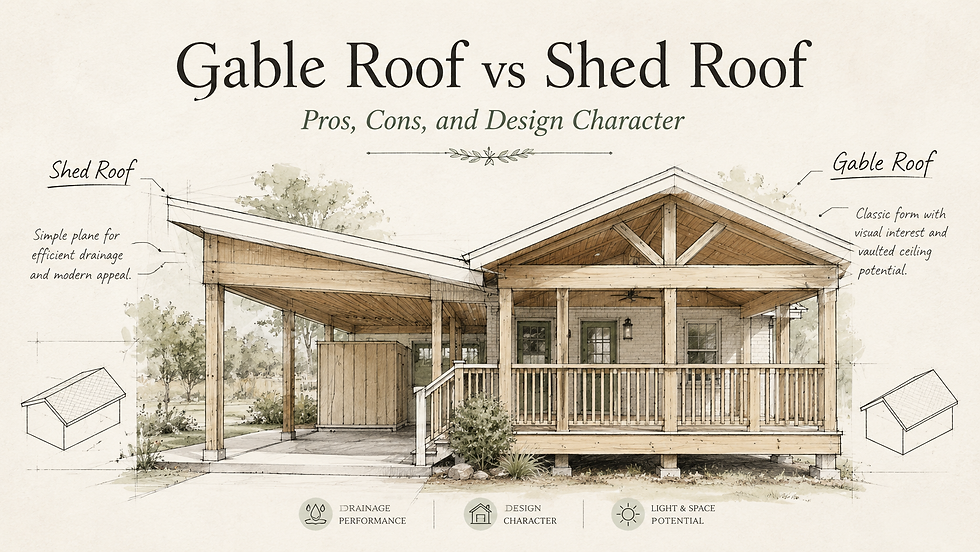
What Is a Gable Roof?
A gable roof is the classic triangular roof shape seen on many homes. It has two sloping sides that meet at a ridge, creating a triangle-shaped wall at each end.
For home additions and porches, a gable roof often gives the new space a strong identity. It can make a porch, screen room, or outdoor structure feel more permanent and intentional.
A gable roof also creates opportunities for vaulted ceilings, exposed rafters, decorative trusses, taller openings, and a more dramatic exterior form.
What Is a Shed Roof?
A shed roof has one sloping roof plane. Instead of two roof slopes meeting at a center ridge, the roof pitches in one direction.
Shed roofs are commonly used for lean-to additions, covered patios, porch extensions, modern home additions, detached studios, and simple roof connections. They are often practical because they usually require less framing complexity than a gable roof.
A shed roof can feel modern, but it does not have to look out of place on a traditional home. With the right proportions, trim, columns, fascia, and materials, a shed roof can look intentional and well-designed.
Gable Roof Pros
1. A gable roof creates a strong architectural statement
One of the biggest advantages of a gable roof is presence. A gable roof gives an addition a clear form. It can turn a porch, screen room, or outdoor living area into a focal point.
This is especially helpful when the addition is visible from the backyard, street, driveway, or main outdoor gathering area. The triangular shape creates a sense of center and structure.
For homeowners who want their addition to feel like a natural and meaningful extension of the house, a gable roof can be a strong choice.
2. It can create beautiful vaulted ceilings
A gable roof naturally allows for vaulted ceilings. This can make a porch, screen room, living room addition, or pavilion feel larger and more open.
Even when the floor area is modest, the added ceiling height can make the space feel generous. This is one reason gable roofs are often used for screened-in porches and outdoor living spaces.
The ceiling can also become a design feature. Exposed beams, rafters, tongue-and-groove boards, or a decorative truss can make the space feel crafted rather than ordinary.
3. A gable roof can help manage rainwater efficiently
A properly designed gable roof can move rainwater away from the structure in two directions. This can be helpful in areas with heavy rain, especially when the roof has the right pitch, gutters, flashing, and downspout locations.
However, the roof connection still matters. Where the new gable meets the existing house, the design needs careful attention. Valleys, flashing, and transitions must be handled properly so water does not collect in the wrong place.
A gable roof can be very effective for rainwater management, but only when the overall roof design is coordinated well.
4. It often feels timeless
If the existing home already has gable rooflines, adding another gable can help the new work feel consistent. This is common with traditional homes, cottages, farmhouses, bungalows, and many older residential styles.
A gable roof can be simple and classic, or it can include more detail. Brackets, trim, exposed rafter tails, and carefully proportioned gable ends can all add character.
When done well, a gable roof does not feel like a trendy choice. It feels like it belongs.
Gable Roof Cons
1. A gable roof is often more expensive than a shed roof
A gable roof is usually more complex to frame than a shed roof. It may require more structure, more roof planes, more trim, and more coordination.
If the new gable roof ties into the existing roof, the cost can increase because of valleys, flashing, roof matching, and possible structural modifications.
For homeowners trying to keep a project simple and budget-conscious, a gable roof may not always be the most efficient option.
2. It can be harder to connect to the existing house
Not every home is easy to add a gable roof to. Existing roof pitch, wall height, second-floor windows, gutters, overhangs, and attic conditions can all affect whether a gable roof works.
Sometimes a gable roof looks good as a standalone idea but creates awkward intersections once it meets the existing house. If the proportions or tie-in location are not right, the addition can look forced.
This is why roofline studies are so important early in the design process. The new roof should not only look good by itself. It should improve the overall composition of the home.
3. It can feel too heavy if the proportions are wrong
A gable roof has more visual weight than a simple shed roof. On a small addition or narrow porch, it can overpower the structure if the pitch, height, or width is not carefully designed.
For example, a gable that is too steep may look oversized. A gable that is too shallow may feel weak. A gable that is too wide may make the addition feel bulky.
The success of a gable roof depends heavily on proportion.
Shed Roof Pros
1. A shed roof is usually simpler and more cost-effective
One of the biggest advantages of a shed roof is simplicity. Because it has one main sloping plane, it is often easier to frame and easier to attach to certain existing walls.
For porch additions, covered patios, side additions, and outdoor walkways, a shed roof can be a practical and efficient solution.
Simple does not have to mean cheap-looking. A shed roof can look beautiful when the columns, fascia, ceiling material, roof pitch, and exterior details are designed with care.
2. It can work well when height is limited
Sometimes the existing house does not allow enough vertical room for a gable roof. There may be second-floor windows, low eaves, an existing gutter line, or another roof above the addition area.
In these situations, a shed roof may fit better. It can slope away from the house and work under existing height limitations.
This makes shed roofs especially useful for additions where the main challenge is making the geometry work cleanly.
3. It can feel clean and modern
A shed roof naturally has a simpler shape. It can give a home addition a clean, modern feel without making the entire house look overly contemporary.
This can work especially well with large windows, patio doors, clerestory windows, and indoor-outdoor living spaces.
For homeowners who prefer a less traditional look, a shed roof can be a great option.
4. It can guide the view outward
A shed roof can create a sense of direction. The roof slope can visually guide the eye toward the backyard, a garden, a pool, a hillside view, or an outdoor gathering area.
This is one of the underrated design benefits of a shed roof. It may not create the same centered drama as a gable roof, but it can create movement and openness.
For porches and outdoor rooms, that directional quality can be very effective.
Shed Roof Cons
1. A shed roof may look too simple if it is not designed carefully
A shed roof can be elegant, but it can also look plain. If the pitch, columns, trim, fascia, ceiling finish, and proportions are not considered, it may feel like an afterthought.
This is especially true when a shed roof is added to a traditional home. The design needs enough detail to connect with the original house.
A good shed roof should look simple on purpose, not simple because no one designed it.
2. Drainage needs careful planning
Because a shed roof drains in one direction, all the rainwater moves toward one edge. That means gutter placement, downspouts, splash areas, grading, and roof slope are very important.
If the roof drains toward a walkway, patio, driveway, foundation, or neighboring property line, it can create problems. The direction of drainage should be part of the design from the beginning.
A shed roof can manage water well, but it needs a clear drainage strategy.
3. The ceiling height can feel uneven
A shed roof creates a high side and a low side. This can be beautiful when used intentionally, but it can also create limitations.
The low side may feel compressed if the roof slope is too steep or if the starting height is too low. In a porch or covered patio, this can affect ceiling fans, light fixtures, views, and the overall feeling of openness.
Before choosing a shed roof, it is important to think about the interior experience, not just the outside appearance.
Gable Roof vs Shed Roof for a Porch Addition
For a porch addition, a gable roof often creates a more finished and dramatic space. It can give the porch a clear center, a vaulted ceiling, and a stronger architectural presence. If the porch is meant to be a major outdoor room, a gable roof can make it feel special.
A shed roof can be a better choice when the porch needs to stretch along the house, stay below existing windows, or connect multiple areas. It can also be ideal for a covered walkway, side porch, or simpler backyard structure.
In some cases, the best design may use both roof types. A gable roof can mark the main gathering area, while a shed roof can cover a secondary porch, connector, or transition space. This creates hierarchy. One roof becomes the main architectural moment, while the other supports the overall design.

Gable Roof vs Shed Roof Cost
In many cases, a shed roof is less expensive than a gable roof because it is simpler to frame and has fewer roof planes. But cost depends on the full project, not just the roof shape.
A simple gable roof on a detached structure may be straightforward. A complicated shed roof tied into an existing house with difficult flashing or drainage conditions may still become expensive.
Roof cost can be affected by:
Roof size
Roof pitch
Existing roof conditions
Structural requirements
Ceiling finish
Exposed beams or trusses
Roofing material
Gutters and drainage
Labor complexity
How the new roof connects to the old roof
The main point is this: roof shape matters, but roof connection often matters more.
Which Roof Looks Better?
A gable roof usually looks better when the addition needs a strong focal point, a traditional form, or a vaulted interior. It can make the new space feel important and permanent.
A shed roof usually looks better when the addition needs simplicity, flexibility, or a clean modern line. It can also be a better choice when the new roof should stay visually quiet and not compete with the existing house.
The better-looking roof is not always the most dramatic one. The better roof is the one that makes the whole home feel more complete.
Quick Comparison: Gable Roof vs Shed Roof
Feature | Gable Roof | Shed Roof |
Overall look | Traditional, strong, architectural | Simple, clean, modern |
Cost | Often higher | Often lower |
Framing complexity | More complex | Usually simpler |
Ceiling potential | Great for vaulted ceilings | Creates high side and low side |
Rainwater management | Drains in two directions | Drains in one direction |
Best use | Main porch, pavilion, prominent addition | Lean-to addition, connector, modern porch |
Visual impact | Strong focal point | More subtle |
Existing roof tie-in | Can be complex | Often simpler, but depends on conditions |
Design risk | Can feel bulky if oversized | Can feel plain if under-designed |
When a Gable Roof Makes More Sense
A gable roof may be the better choice when:
You want the addition to feel like a major architectural feature
The existing home already has gable rooflines
You want a vaulted ceiling
The porch or addition will be highly visible
You want a more traditional or timeless appearance
The structure needs a strong front-facing form
A gable roof is especially strong for screened-in porches, backyard pavilions, front porch additions, and outdoor rooms where the roof itself becomes part of the experience.
When a Shed Roof Makes More Sense
A shed roof may be the better choice when:
You want a simpler and often more cost-effective solution
Existing windows or rooflines limit height
The addition needs to stretch along the house
You prefer a cleaner or more modern look
You want the roof to feel subtle instead of dominant
The project needs a practical connection to the existing structure
A shed roof is especially useful for covered patios, side additions, lean-to structures, long porches, and modern outdoor living spaces.
Final Thoughts
The gable roof vs shed roof pros and cons discussion should not be reduced to “traditional vs modern” or “expensive vs cheap.” Both roof types can be beautiful. Both can also look wrong if they are poorly proportioned or badly connected to the existing home.
A gable roof brings character, symmetry, and volume. A shed roof brings simplicity, flexibility, and efficiency.
The right choice depends on the existing house, the roof connection, the desired ceiling height, the drainage strategy, the budget, and the feeling you want the new space to create.
For homeowners planning a porch, screen room, home addition, or outdoor living project, the roof shape should be studied early. It is one of the most important design decisions in the project. When done well, the roof does more than cover the space. It gives the addition its character.

